


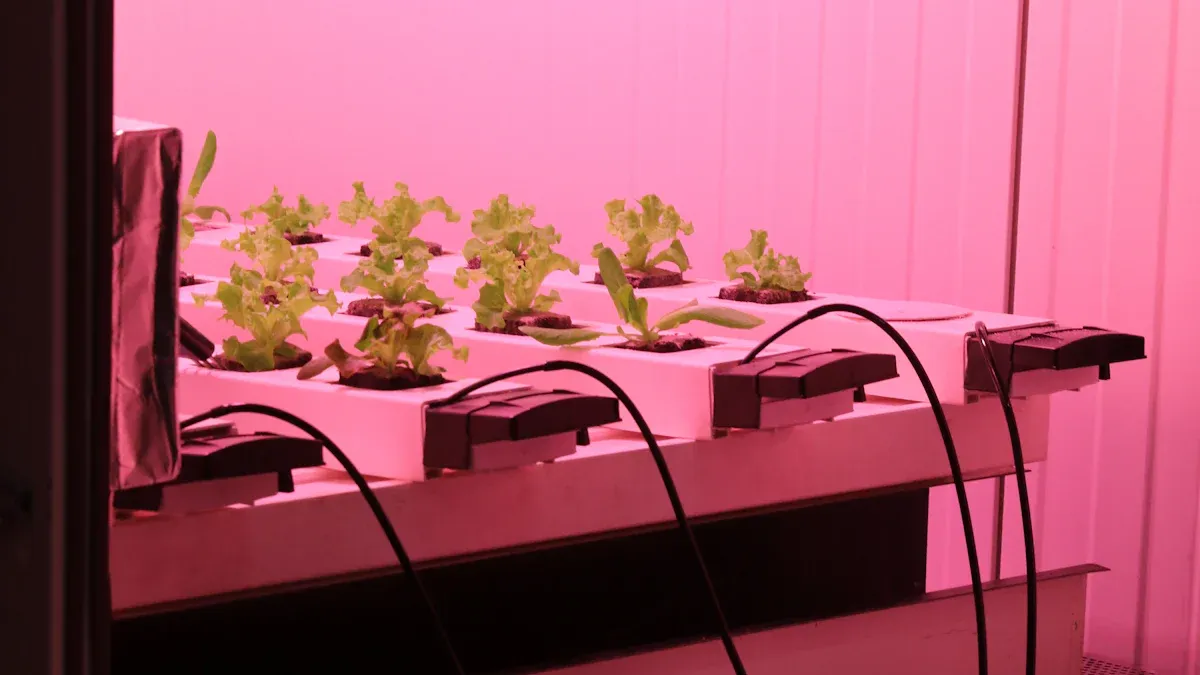
Grow lights help plants thrive indoors by delivering the right type of artificial light. I rely on LED Grow Light technology to supply energy for photosynthesis, which supports healthy growth and flowering. Scientific studies show that light spectrum, intensity, and photoperiod all play vital roles in plant development. Take a look at how these factors influence growth:
Aspect | Findings |
|---|---|
Light Spectrum | Specific wavelengths trigger different responses in plants. |
Light Intensity | Stronger light boosts photosynthesis and yield. |
Photoperiod | The timing of light and dark impacts seed quality and production. |
Grow lights provide essential light for indoor plants, enabling photosynthesis and healthy growth.
LED grow lights are energy-efficient, lasting longer and producing less heat compared to HID and fluorescent lights.
Different light spectrums affect plant growth; blue light supports leafy growth, while red light promotes flowering.
Adjust the distance and duration of grow lights based on plant needs to avoid damage and ensure optimal growth.
Using timers helps maintain consistent light cycles, which is crucial for plant health and development.
LED grow lights can be tailored to various plant types, making them versatile for different growth stages.
Monitoring plant health through leaf color and growth patterns helps identify light issues early.
Investing in LED technology can lead to long-term cost savings and a lower environmental impact.
When I set up an indoor garden, I rely on grow lights to give my plants the energy they need. A grow light is a specialized lighting system that supports photosynthesis and plant growth, especially in places where sunlight is limited or unavailable. Unlike regular bulbs, grow lights emit a specific spectrum that plants require for healthy development. I use these lights to create the right environment for my herbs, vegetables, and flowers, even in the middle of winter. Grow lights play a key role in horticulture, hydroponics, and home gardening. They allow me to grow fresh produce year-round, regardless of outdoor conditions.
Grow lights work by replicating the qualities of natural sunlight. I often choose full spectrum LED Grow Light systems because they closely match the wavelengths plants use for photosynthesis. Here’s how these artificial light sources mimic sunlight:
Full spectrum grow lights use phosphor-coated diodes to turn narrow blue light into a broad spectrum, similar to sunlight.
They emit light across the 400-700nm range, which covers the photosynthetically active radiation (PAR) plants need.
Different wavelengths serve unique roles: blue light encourages leafy growth, while red light supports flowering and fruiting.
I adjust the type and intensity of my grow lights based on the growth stage of my plants. This flexibility helps me achieve strong, healthy results indoors.
Understanding the relationship between light spectrum and plant growth helps me make better choices for my indoor garden. Each color in the spectrum affects plants differently. I use this table to guide my lighting setup:
Light Spectrum | Wavelength (nm) | Effects on Plant Growth |
|---|---|---|
Blue Light | 430-450 | Encourages vegetative growth, chlorophyll formation, and seedling growth regulation. |
Red Light | 600-700 | Promotes photosynthesis, stem and leaf growth, and regulates flowering and dormancy. |
Far Red Light | 700-850 | Influences flowering cycles in short-day plants, especially effective at 730nm. |
I always check that my artificial light sources provide enough PAR. PAR is the energy plants use for photosynthesis. If my grow lights do not deliver enough PAR, my plants may grow slowly or develop small leaves. I prefer LED Grow Light systems because they offer high PAR efficiency and let me tailor the spectrum for each plant’s needs. By managing the spectrum, intensity, and timing, I can help my plants thrive indoors.
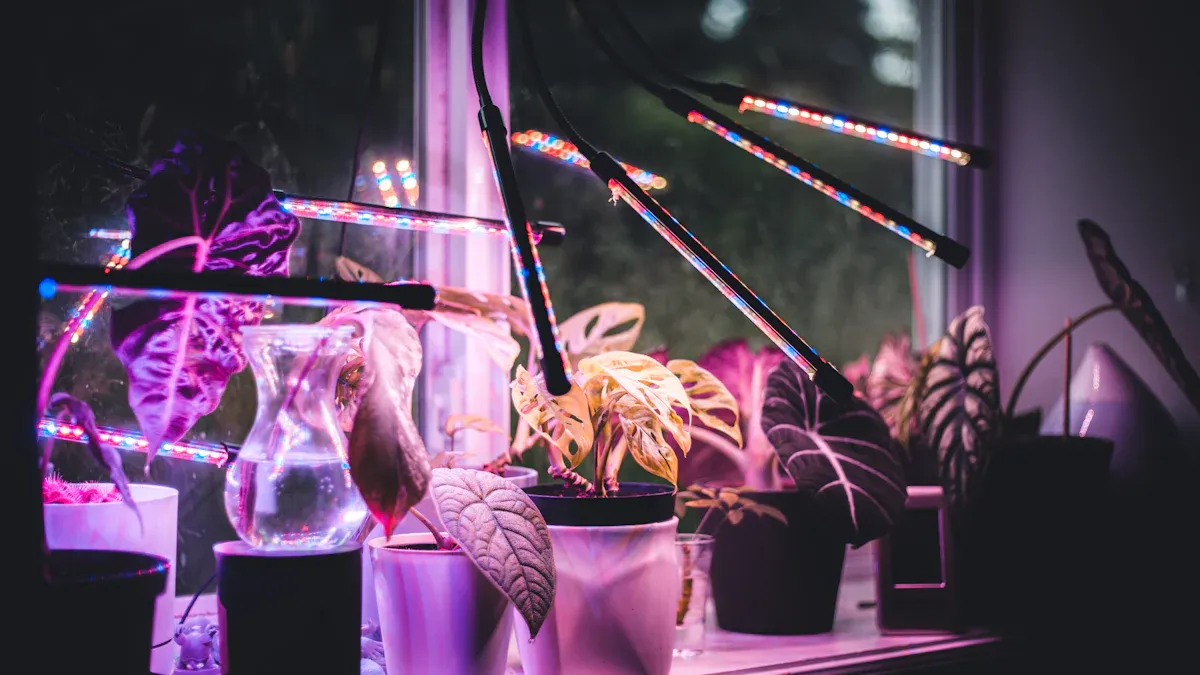
I often choose LED grow light systems for my indoor garden because they use electroluminescence to produce light. When I power up these lights, electrons inside the light emitting diodes get excited and jump to higher energy levels. As they return to their original state, they release energy in the form of light. The color of this light depends on the semi-conductive material inside each diode. I can select grow lights that emit specific colors, such as blue or red, to match the needs of my plants. This targeted approach makes LED grow light technology highly efficient. It produces only the wavelengths that plants use for photosynthesis, which means less wasted energy and lower heat output.
Electroluminescence allows me to control the color of light by choosing different diode materials.
I can match the light spectrum to the absorbance peaks of plant pigments, like phytochrome.
LED grow light systems convert more energy into light and less into heat, making them safer and more cost-effective.
I appreciate that the principle of electroluminescence dates back to 1907. Today, it forms the foundation of modern grow lights and supports advanced indoor gardening.
Full spectrum LED grow light systems have transformed how I care for my plants. These lights mimic natural sunlight, supporting every stage of growth from seedling to harvest. I rely on the adjustable spectrum to optimize conditions for each phase:
Blue spectrum encourages healthy seed germination and chlorophyll formation.
Blue light supports strong leaf and stem development during vegetative growth.
Red spectrum boosts flower and fruit production in the flowering phase.
Both red and blue lights enhance photosynthesis for better fruit development.
I use full spectrum grow lights because they provide balanced light, including blue (400-500 nm), red (600-700 nm), green, and even some UV. This coverage helps my plants grow robustly. The intensity and coverage area of my LED grow light setup allow me to match light needs to each growth stage. I also benefit from lower electricity consumption and a long lifespan, often exceeding 50,000 hours. The reduced heat output means I do not need extra cooling systems, and my plants stay safe from heat stress. I can adjust the spectrum to enhance bud development during flowering, which gives me more control over my harvest.
Full spectrum LED grow light systems closely replicate sunlight.
I can optimize the light for different plant stages, improving growth and yield.
Lower heat and energy use help me save on operating costs.
I always compare energy efficiency when selecting grow lights for my indoor garden. LED grow light systems stand out for their high efficiency, long lifespan, and low heat generation. I reviewed recent studies and found that LED grow lights outperform HID and fluorescent options in several key areas:
Light Type | Energy Efficiency | Lifespan | Heat Generation | Initial Cost | Long-term Cost |
|---|---|---|---|---|---|
LED | High | Long | Low | Higher | Lower |
HID | Moderate | Moderate | High | Moderate | Higher |
Fluorescent | Low | Short | Moderate | Low | Higher |
I invest in LED grow light systems because they use less electricity and last much longer than other types. The lower heat output protects my plants and reduces the need for ventilation. Although the initial cost is higher, I save money over time due to fewer replacements and lower energy bills.
NASA has published research on using LED grow lights in controlled environments, such as space stations. Their findings show that these lights provide optimal wavelengths for photosynthesis and reduce power consumption. NASA’s HELIAC system uses targeted solid-state LEDs for efficient plant growth, allowing precise control over light output for different species and growth stages. The system is robust, easy to maintain, and minimizes safety hazards. Astronauts have reported better rest due to circadian lighting adjustments made possible by LED technology. These advances have influenced commercial agriculture and aquarium lighting, making LED grow light systems a top choice for professionals and hobbyists alike.
Tip: I always check the coverage area and intensity of my LED grow light setup to ensure my plants receive the right amount of light for each growth stage.
When I plan my indoor garden, I always consider the different types of grow lights available. Each type has unique features, strengths, and best-use scenarios. I want to share my experience with the three main categories: HID, fluorescent, and LED Grow Light systems.
HID (High-Intensity Discharge) grow lights have been a staple in indoor gardening for years. I often see two main types: Metal Halide (MH) and High-Pressure Sodium (HPS). These bulbs produce intense light, which helps plants grow quickly and flower abundantly. I use HID grow lights when I need strong light penetration for larger plants or dense canopies.
Limitations | Applications |
|---|---|
Energy Inefficiency | Proven Performance: Effective in promoting plant growth and flowering. |
Heat Emission | Cost-Effective Initial Investment: Lower upfront cost compared to LEDs. |
Shorter Lifespan | Light Penetration: Strong light penetration for uniform coverage. |
HID grow lights generate a lot of heat, so I always set up extra ventilation or cooling. They work well for flowering and fruiting plants that need high-intensity light. However, I replace the bulbs more often than with other systems.
Fluorescent grow lights are another popular choice, especially for beginners or those growing leafy greens. I like using them for seedlings, herbs, and houseplants. These lights emit a moderate amount of blue light, which supports vegetative growth. They are energy-efficient compared to older incandescent bulbs, but not as efficient as LED Grow Light systems.
Fluorescent lights have a lower upfront cost and are easy to find. I notice they do not get as hot as HID lights, so I can place them closer to my plants. However, they often lack enough red light for optimal flowering and fruiting. Sometimes, I supplement them with other grow lights to achieve better results.
Note: Fluorescent grow lights work best for leafy greens and seedlings. For fruiting or flowering plants, I recommend combining them with another light source.
I always compare the main features of different types of grow lights before making a decision. Here is a table that summarizes the key differences:
Type of Grow Light | Technology Description | Efficiency | Heat Output | Lifespan |
|---|---|---|---|---|
LED | Diodes emitting a spectrum closest to sunlight, with options for purple UV light for flowering plants. | At least twice as efficient as HID and three times more efficient than fluorescent. | Lower heat output compared to HID. | Longer lifespan than both HID and fluorescent. |
HID | High-Intensity Discharge bulbs that consume significantly more energy. | Less efficient; a 200-watt LED matches a 600-watt HPS in lumens. | Higher heat output, requiring additional cooling. | Shorter lifespan than LED. |
Fluorescent | Traditional bulbs that emit a limited spectrum of light. | Least efficient; not suitable for large areas. | Moderate heat output. | Shorter lifespan than LED. |
I find that LED Grow Light systems offer the most flexibility. I can adjust the spectrum and intensity to match each plant’s needs. They use less electricity and last much longer than HID or fluorescent options. HID grow lights still have a place in my garden when I need high-intensity light for flowering. Fluorescent lights remain a good choice for starting seeds or growing leafy greens.
Key points I consider:
LED grow lights are at least twice as efficient as HID grow lights.
LED grow lights are three times more efficient than fluorescent grow lights.
For seedlings and vegetative growth, I prefer LEDs for their adjustable spectrum and low heat.
For flowering and fruiting, HID lights provide strong intensity and proven results.
By understanding the strengths of different types of grow lights, I can create the best environment for my plants at every stage.
When I select grow lights for my indoor garden, I always match the light to my plants’ needs and growth stages. Here are the main factors I consider:
Type of Light: I choose between LED Grow Light, fluorescent, or incandescent based on efficiency and heat output. LED Grow Light offers the best energy savings and spectrum control.
Light Spectrum: I make sure the light provides a full spectrum or a balanced mix of red and blue. This supports both vegetative growth and flowering.
Placement: I position my grow lights 6 to 24 inches above the plants. The exact distance depends on the type of light and the plant’s requirements.
Duration: Most of my plants thrive with 12 to 16 hours of light each day. I always provide at least 8 hours of darkness to support healthy cycles.
Beam Angle: I check the beam angle. Narrow beams can be placed further away, while wider beams need to be closer for even coverage.
I adjust the distance from the plants based on the light type. For example, I keep LED Grow Light systems a bit farther away than fluorescent lights to avoid excess light intensity.
Understanding how light intensity changes with distance helps me set up my grow lights for the best results. The inverse-square law tells me that when I double the distance between the light and my plants, the light intensity drops to a quarter of its original value. I always adjust the height of my lights to maintain optimal light intensity for each plant.
To measure how much usable light my plants receive, I look at PPFD (Photosynthetic Photon Flux Density) and DLI (Daily Light Integral). These values help me decide how long and how strong my lighting should be. Here is a table I use to guide my setup for common crops:
Crop | Recommended DLI range (mol∙m−2∙d−1) |
|---|---|
Lettuce | 12−17 |
Basil | 15−25 |
Tomato | 20−30 |
Cucumber | 20−30 |
Spinach | 14−20 |
Cannabis | 20−45 |
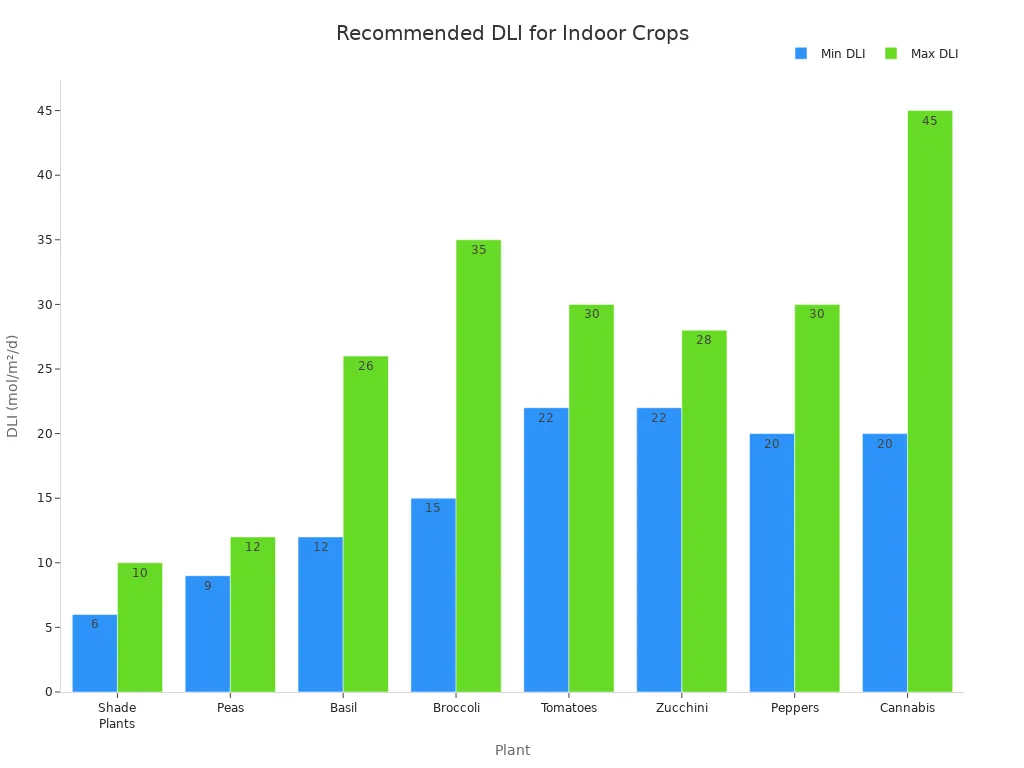
For most leafy greens, I set the light duration to 12-14 hours. Fruiting crops like tomatoes or peppers need 16-18 hours of light duration for strong growth. I monitor the light intensity with a meter to ensure my plants get the right amount of energy.
I have learned that improper use of grow lights can harm plants. Too much light intensity or the wrong duration can cause leaf burn, stunted growth, or disrupt natural cycles. Here are some common mistakes and how I prevent them:
Placing lights too close can burn leaves. I always check for signs of bleaching or curling.
Using the wrong spectrum can delay flowering or cause poor fruit set. I match the spectrum to the plant’s stage.
Ignoring seasonal light/dark cycles can confuse plants. I maintain regular periods of darkness to support healthy growth.
Overexposing plants to artificial light can disrupt pollinator relationships and increase frost risk for some species.
Tip: I use timers to control light duration and avoid accidental overexposure. I also direct my grow lights only where needed to reduce light pollution and protect plant health.
By carefully managing light intensity, distance, and duration, I help my plants thrive indoors. I always observe my plants and adjust my setup as needed for the best results.
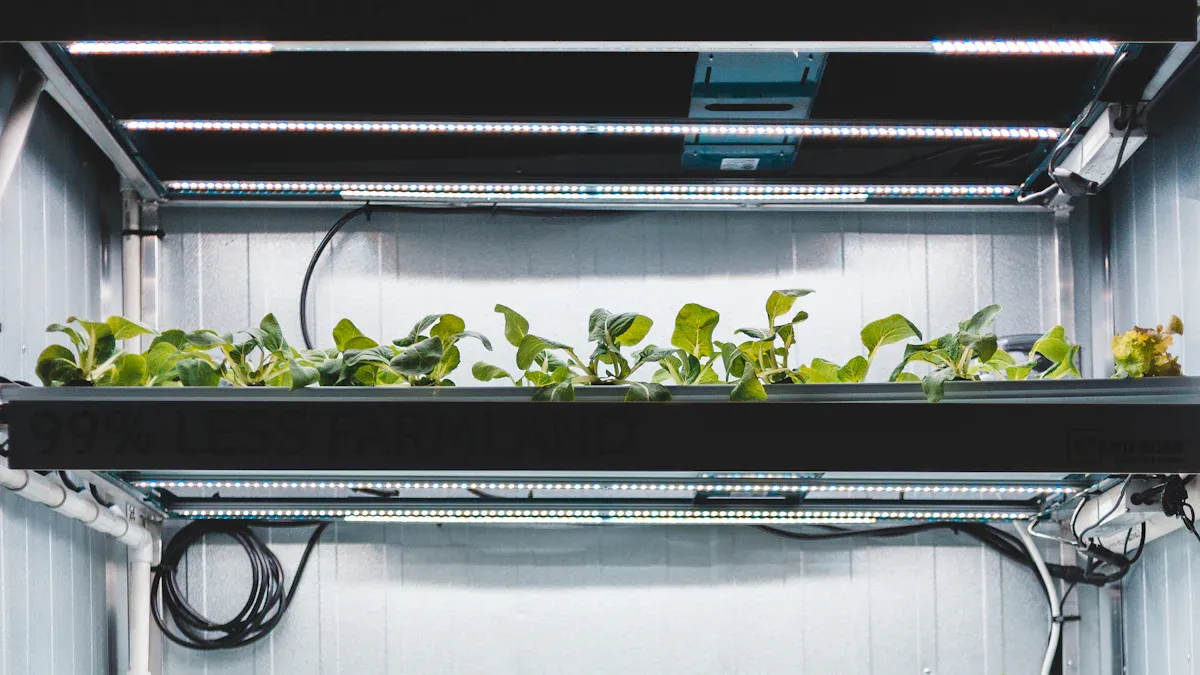
I always start by adjusting the light spectrum to match the needs of my plants. Grow lights give me control over the wavelengths my plants receive. Leafy greens thrive under a blue-heavy spectrum, which encourages strong vegetative growth and healthy leaves. Flowering plants need more red light during their blooming phase. Herbs benefit from a balanced spectrum, using both red and blue spectrums for steady growth.
Here is a table I use to guide my setup:
Crop Type | Ideal PPFD (µmol/m²/s) | Light Duration (hrs/day) | Best Spectrum |
|---|---|---|---|
Leafy Greens | 250–400 | 16-18 | Blue-heavy |
Fruit-bearing | 600–900 | 18-12 (veg/flower) | Red-heavy |
Herbs | 400–700 | 12-16 | Balanced |
Leafy greens thrive under a blue-heavy spectrum for optimal vegetative growth.
Flowering plants require a red-heavy spectrum during their flowering stage.
A balanced spectrum is beneficial for herbs, which need both blue and red light.
I use LED Grow Light systems because they allow me to fine-tune the spectrum for each crop. This flexibility helps me create the ideal growth environment for every plant in my garden.
Managing the photoperiod is essential for healthy development. I set the light and dark cycles based on the species I grow. For cannabis, I use a photoperiod of 12 hours light and 12 hours dark to induce flowering. Continuous darkness for 12 hours ends the vegetative stage and starts blooming. I also adjust the duration of long day lighting to optimize floral biomass and cannabinoid concentration.
Floral biomass is optimized with minimized long day lighting duration.
THC concentration reaches its peak at 42 days of long day lighting.
CBD concentration in low CBD plants is highest at 49–50 days of long day lighting.
Different long day lighting durations can maximize floral biomass and cannabinoid concentration in Cannabis sativa.
I rely on timers to maintain consistent cycles. This approach supports photosynthesis and helps my plants transition smoothly between growth stages.
I monitor plant health by observing foliage color, growth patterns, and overall vigor. Adequate light from grow lights enables plants to convert carbon dioxide and water into energy. If my plants lack chlorophyll, they turn pale and develop elongated stems as they reach for light.
I look for these key indicators:
Placement: I adjust the distance of grow lights based on the growth stage.
Temperature: I check for heat stress, especially with different lighting types.
Spectrum: I match the spectrum to the plant’s current stage.
Stage of growth cycle: I switch spectrums as plants move from vegetative to flowering.
Timing and cycle: I keep regular light exposure for optimal growth.
Coverage area: I ensure all plants receive enough light.
Number of plants: I avoid overcrowding to prevent competition for light.
Mid-green foliage shows correct light levels.
Bleached appearance suggests too much light exposure.
Dark green foliage indicates insufficient light.
Bleached seedlings and stunted growth signal excessive light.
Yellow-green foliage suggests high light intensity.
Tip: I always observe my plants daily. Quick adjustments to spectrum, distance, or duration help me maintain strong plant health and maximize yield.
I always look for ways to maximize my investment in indoor gardening. LED grow lights stand out for their impressive lifespan and cost efficiency. When I compare them to HID and fluorescent options, the difference is clear. LED grow lights last much longer, which means I replace bulbs less often and save money over time.
Light Type | Lifespan (Hours) |
|---|---|
LED Grow Lights | 50,000 - 100,000 |
HID Grow Lights | ~20,000 |
Fluorescent Lights | ~20,000 |
I notice that LED grow lights can operate for up to 100,000 hours. This longevity reduces maintenance and replacement costs. Over five years, the savings become even more apparent.
Lighting Type | Capital Expense (CapEx) | Operational Expense (OpEx) | Total Cost After 5 Years |
|---|---|---|---|
LED | $1000 | $6000 | $7000 |
HID | $200 | $10000 | $12000 |
LED grow lights consume about 30% less electricity than HID systems. I see lower energy bills and fewer bulb replacements. The reduced heat output also means I spend less on cooling equipment. These savings make LED grow lights a smart choice for any indoor garden.
Tip: I always factor in long-term costs when choosing lighting. LED grow lights help me keep my expenses low and my plants healthy.
I use LED grow lights because they adapt to the needs of many plant species and growth stages. The technology allows me to customize the light spectrum for vegetables, herbs, seedlings, and flowering plants. I adjust the wavelengths to match each crop’s requirements.
Colors | Wavelength, nm | Value for plants |
|---|---|---|
Red and orange | 720-600, 620-595 | Main energy sources for photosynthesis; influence growth rates and flowering. |
Purple and blue | 490-380 | Crucial for photosynthesis and root development; stimulate early flowering. |
Ultra-violet rays | 380-280 | Prevent stretching and enhance vitamin production; excess can be harmful. |
Vegetables thrive under continuous white light from LED grow lights. I use a red to blue ratio of 1:2 for seedlings to promote strong roots. After picking, I reduce light intensity and balance the red to blue ratio at 1:1. Flowering and fruiting plants respond best to increased red light. This flexibility lets me grow a wide range of crops with one lighting system.
I can tailor the spectrum for each plant.
LED grow lights support every stage, from seedling to harvest.
I achieve better yields and healthier plants.
I care about the environment and want my gardening practices to be sustainable. LED grow lights offer significant environmental benefits. They use less energy, which lowers greenhouse gas emissions. The mercury-free design makes disposal safer. I also notice that LED grow lights produce less heat, reducing the load on HVAC systems.
A study by the U.S. Department of Energy shows that LED grow lights reduce pollution and energy usage. The International Energy Agency reports a 30% reduction in carbon footprint due to the long lifespan of LEDs. Fewer replacements mean less waste.
Lighting Type | Carbon Footprint | Energy Consumption | Heat Output |
|---|---|---|---|
LED Grow Lights | Low | Low | Minimal |
HID Grow Lights | High | High | High |
Fluorescent Lights | Moderate | Moderate | Moderate |
LED grow lights lower energy consumption and greenhouse gas emissions.
They minimize wasted energy with precision lighting.
The non-toxic design makes them safer for the environment.
I choose LED grow lights because they help me grow healthy plants while protecting the environment.
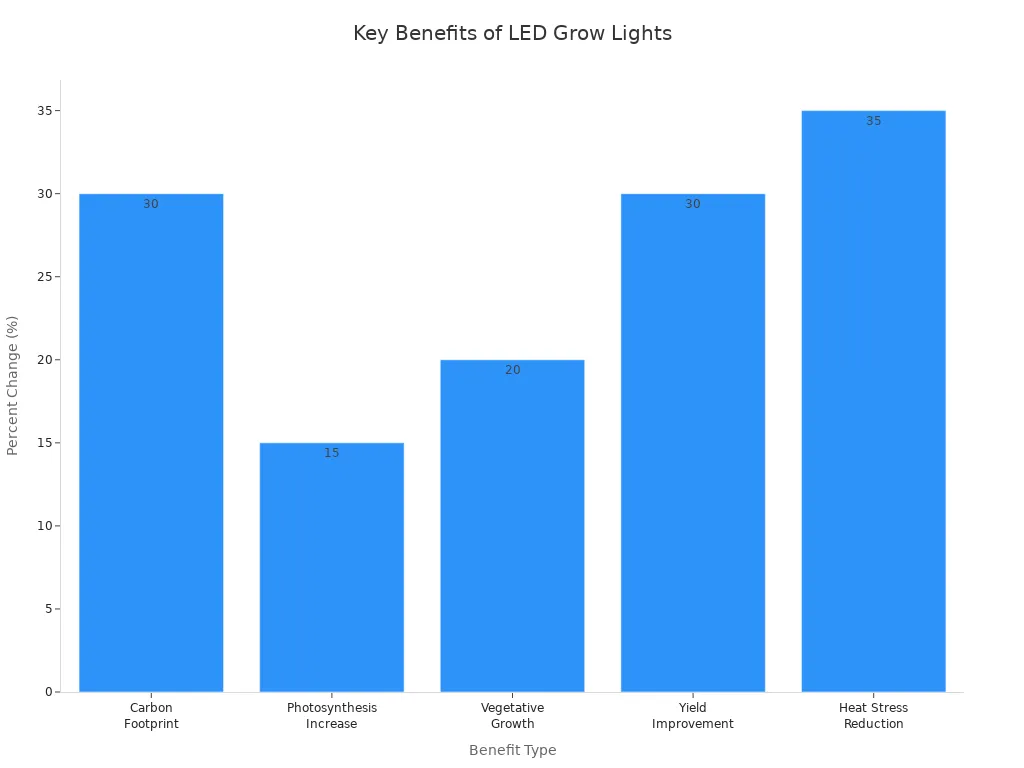
LED Grow Light technology has changed how I grow plants indoors. I see faster growth, higher yields, and healthier plants when I match spectrum, intensity, and timing to each crop. Research shows LED lights boost photosynthesis by 15% and cut heat stress by 35%. They also lower energy use and reduce environmental impact.
Benefit | Result |
|---|---|
Faster Growth | 20% quicker vegetative growth |
Better Yields | Up to 30% more quality and quantity |
Lower Carbon Footprint | 30% reduction in emissions |
I always experiment with spectrum and duration, using timers and PAR meters to fine-tune my setup. Every plant responds differently, so I watch for changes and adjust as needed. For advanced tips, I recommend exploring resources on measuring light performance, sustainability, and new grow light techniques.
I usually keep my LED Grow Light 12 to 24 inches above the canopy. This distance gives strong light without burning leaves. I adjust the height as plants grow or if I notice signs of stress.
Most plants thrive with 12 to 16 hours of light daily. I use timers to maintain a consistent schedule. For flowering, I often switch to 12 hours of light and 12 hours of darkness.
Yes, I use LED Grow Light for vegetables, herbs, flowers, and even succulents. I adjust the spectrum and intensity to match each plant’s needs. This flexibility helps me grow a wide range of crops indoors.
LED Grow Lights produce much less heat than HID or fluorescent lights. I rarely need extra cooling. The lower heat output keeps my plants safe and reduces energy costs.
I watch for healthy, green leaves and steady growth. If plants stretch or look pale, I increase light intensity or adjust the distance. I sometimes use a PAR meter to check light levels.
LED Grow Lights use less power than traditional grow lights. I notice a smaller increase in my electricity bill, especially when I replace older systems. The energy savings add up over time.
I avoid running lights nonstop. Most plants need darkness for healthy growth. I stick to recommended photoperiods to prevent stress and support natural cycles.
For seedlings, I use more blue light to encourage strong roots and leaves. During flowering, I switch to a red-heavy spectrum. Many LED Grow Lights let me adjust the spectrum for each stage.


 English
