
Views: 0 Author: Site Editor Publish Time: 2025-10-18 Origin: Site


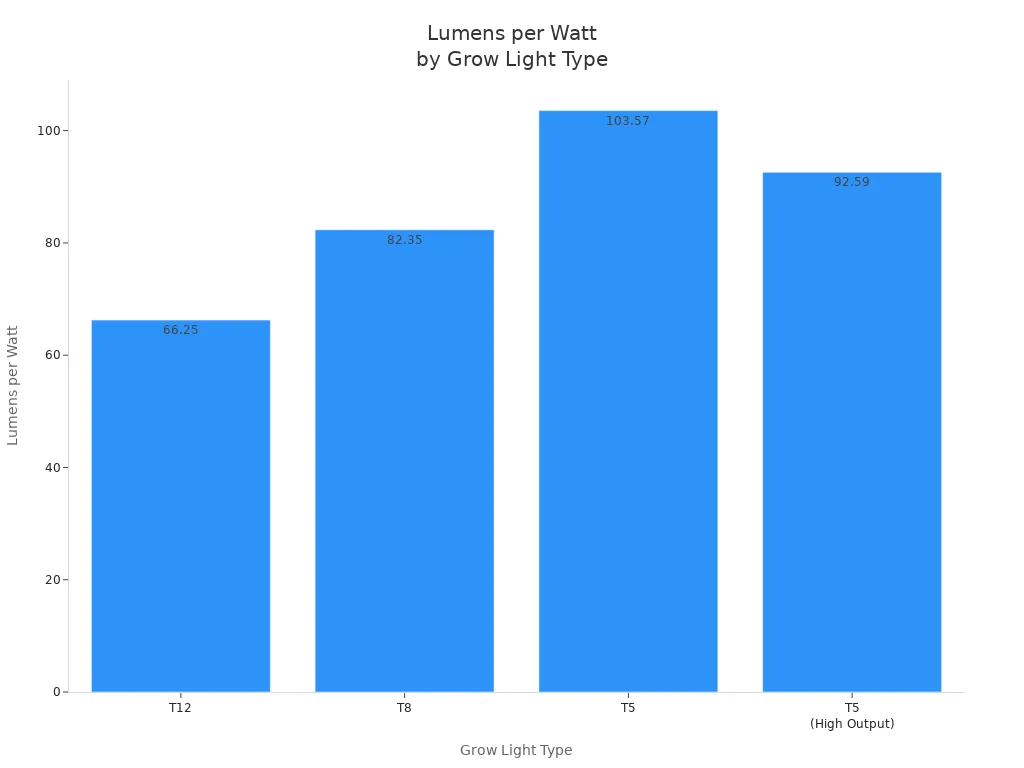
When I ask myself, is t5 or t8 better for grow lights? led grow light, I always look at the facts. T5 bulbs deliver more light per watt than T8, making them a top choice for strong plant growth. Check this out:
Type | Initial Lumens | Wattage | Lumens per Watt |
|---|---|---|---|
T12 | 2650 | 40 | 66.25 |
T8 | 2800 | 34 | 82.35 |
T5 | 2900 | 28 | 103.57 |
T5 (High Output) | 5000 | 54 | 92.59 |
I know lighting needs change with each plant and setup. I always recommend choosing what matches your plants’ needs best, whether you use fluorescent or led.
T5 grow lights are more efficient, delivering more light per watt, making them ideal for energy-conscious growers.
T8 grow lights produce higher PPFD, making them suitable for high-light plants like tomatoes and succulents.
T5 lights have a shorter lifespan of 10,000 to 20,000 hours, while T8 bulbs can last up to 30,000 hours, reducing replacement frequency.
Consider the size of your grow space; T5 lights fit better in tight areas due to their slim design.
Match the light spectrum to your plants' needs; T5 offers a balanced spectrum, while T8 leans towards blue light for vegetative growth.
LED grow lights provide the best energy efficiency and longest lifespan, making them a great investment for serious growers.
Always assess your plants' light requirements before choosing between T5, T8, or LED options to ensure optimal growth.
Regular maintenance of your grow lights, including cleaning and timely bulb replacement, is crucial for healthy plant growth.
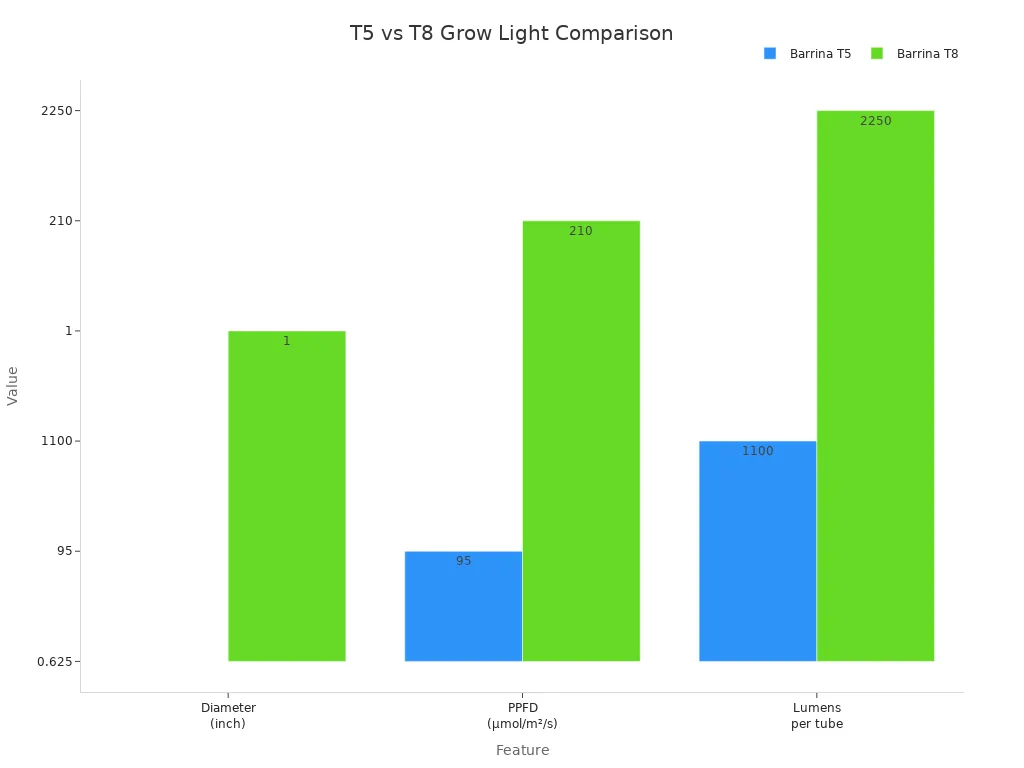
When I set up my grow space, I always look for lights that deliver strong results. T5 grow lights stand out because of their slim design and impressive efficiency. Each tube measures just 5/8 inch in diameter, so I can fit them into tight shelves or racks. T5 bulbs use advanced technology to produce a balanced spectrum, which means my plants get both red and blue light for every growth stage. I see healthy seedlings and lush greens under T5 fixtures. These lights usually run at 28 to 54 watts, and high-output models can reach up to 5000 lumens. I also appreciate the long lifespan—T5 bulbs last between 10,000 and 20,000 hours, so I don’t have to replace them often.
T8 grow lights offer a different set of advantages. The tubes are thicker, measuring 1 inch in diameter, which makes them more durable for busy grow rooms. I notice that T8 lights deliver higher PPFD at the same distance compared to T5, reaching up to 210 μmol/m²/s at 8 inches. This means T8 is perfect for high-light plants like tomatoes and succulents. T8 bulbs use about 32 watts and produce between 2000 and 3100 lumens per tube. The spectrum leans toward blue light, so I use T8 for seedlings and vegetative growth. T8 bulbs last up to 24,000 to 30,000 hours, which saves me money over time.
When I compare t5 vs t8, I see clear differences in size, efficiency, light output, and cost. T5 lights cost more up front, but they offer higher efficiency and a balanced spectrum. T8 lights are more affordable and widely available, making them a practical choice for larger setups.
Here’s a quick comparison:
Feature | T5 Grow Light | T8 Grow Light |
|---|---|---|
Diameter | 5/8 inch (slim) | 1 inch (thicker) |
Wattage | 28–54W | 32W |
Light Output | 2900–5000 lumens | 2000–3100 lumens |
PPFD @ 8″ | 90–100 μmol/m²/s | 210 μmol/m²/s |
Spectrum | Balanced (red + blue) | Blue-leaning |
Lifespan | 10,000–20,000 hours | 24,000–30,000 hours |
Cost | Higher initial investment | More affordable |
Tip: If you want to maximize your budget, T8 bulbs cost up to half as much as T5 bulbs. I always recommend checking your plant’s light needs before choosing.
Key Points to Remember:
T5 is best for energy-efficient systems and balanced growth.
T8 works well for high-light plants and larger grow areas.
Both options support LED Grow Light setups for indoor gardening.
I always choose the light that matches my plant’s needs and my space. The right choice depends on your goals and budget.
When I set up my grow room, I always check the light output and PPFD. These numbers tell me how much usable light my plants get. T5 and T8 both deliver strong results, but I see differences when I measure them side by side. T5 grow lights give me a high lumen output, which means my seedlings and leafy greens get plenty of energy. T8 grow lights push out even more PPFD at the same distance, so I use them for plants that need intense lighting.
I ran a test with T5, T8, and LED tube light. I tracked growth rates and phosphorus uptake. Here’s what I found:
Light Type | Growth Rate | Phosphorus Uptake |
|---|---|---|
T5 | Lower than T8 | Not specified |
T8 | Higher than T5 | Increased |
LED | Highest | Not specified |
T8 lights helped my tomatoes and peppers grow faster than T5. LED lights gave me the best results overall. I always recommend matching the light type to your plant’s needs. If you want the strongest growth, LED tube light is hard to beat. For most home setups, T8 grow lights offer a great balance of power and cost.
Tip: Place your lights close to the plants and use reflectors. This boosts PPFD and makes every watt count.
I always look for ways to save energy and lower my bills. T5 and T8 both use less power than older lighting options. T5 lights run at 28 to 54 watts, while T8 lights use about 32 watts. I notice that T5 lights deliver more lumens per watt, so they use energy efficiently. T8 lights last longer, which means I replace bulbs less often and save money over time.
LED lights take energy efficiency to the next level. I switched some of my fixtures to LED, and my power use dropped. LED grow lights use advanced technology to convert electricity into light with very little waste. If you want to cut costs and help the environment, LED is a smart choice.
T5: High lumen output, good efficiency
T8: Lower wattage, longer lifespan
LED: Best energy efficiency, lowest power use
I always check the spectrum before I buy new lights. Plants need both blue and red light to grow strong. T5 lights give me a balanced spectrum, so my seedlings and mature plants thrive. T8 lights lean toward blue, which helps with vegetative growth. I use T8 for starting seeds and growing leafy greens.
Here’s a quick look at how different light colors help plants:
Light Spectrum | Wavelength Range (nm) | Role in Photosynthesis |
|---|---|---|
Blue Light | 400–500 | Promotes stomatal opening, enhances chlorophyll absorption, and supports vegetative growth. |
Red Light | 600–700 | Most effective for photosynthesis, encourages stem and leaf growth, and is crucial for flowering. |
LED grow lights let me fine-tune the spectrum. I can pick fixtures that boost red light for flowering or blue light for leafy growth. This flexibility helps me get the best results for every plant.
Note: Balanced spectrum lighting supports healthy growth at every stage. I always match the spectrum to my plant’s needs.
I always ask myself, is t5 or t8 better for grow lights? led grow light. I compare t5 vs t8 and LED options for every setup. T5 gives me strong, balanced lighting. T8 works well for high-light plants and larger spaces. LED tube light offers the best energy efficiency and growth rates. I choose the light that fits my goals and budget.
When I choose grow lights, I always pay close attention to heat output. Heat can make or break an indoor garden. T5 grow lights stand out because they produce very little heat. I can place them close to my plants without worrying about burning leaves or raising the room temperature too much. This low heat output helps me keep my growing environment stable, which is critical for temperature-sensitive plants like lettuce, herbs, and seedlings.
T8 grow lights give off a bit more heat than T5, but I find it easy to manage with good airflow or a small fan. I never have to worry about overheating my space if I use proper ventilation. This makes T8 a solid choice for larger grow rooms or for growers who want a simple setup.
Here’s how I see the differences:
T5 grow lights:
Very low heat output
Safe to place close to plants
Perfect for tight spaces and delicate crops
T8 grow lights:
Slightly higher heat output
Still manageable with basic ventilation
Good for bigger rooms or setups with more space
Tip: I always check the temperature under my lights. If I feel too much warmth, I add a fan or adjust the distance. This keeps my plants healthy and prevents stress.
When I switched some of my fixtures to led, I noticed a big drop in heat. Led tube light runs cool, so I can pack more lights into my grow area without worrying about heat buildup. This lets me focus on plant growth instead of cooling my room.
Choosing the right grow light means thinking about heat as much as light. I always recommend T5 for growers who want a cool, controlled environment. T8 works well if you have space and airflow. If you want the coolest option, led is the way to go.
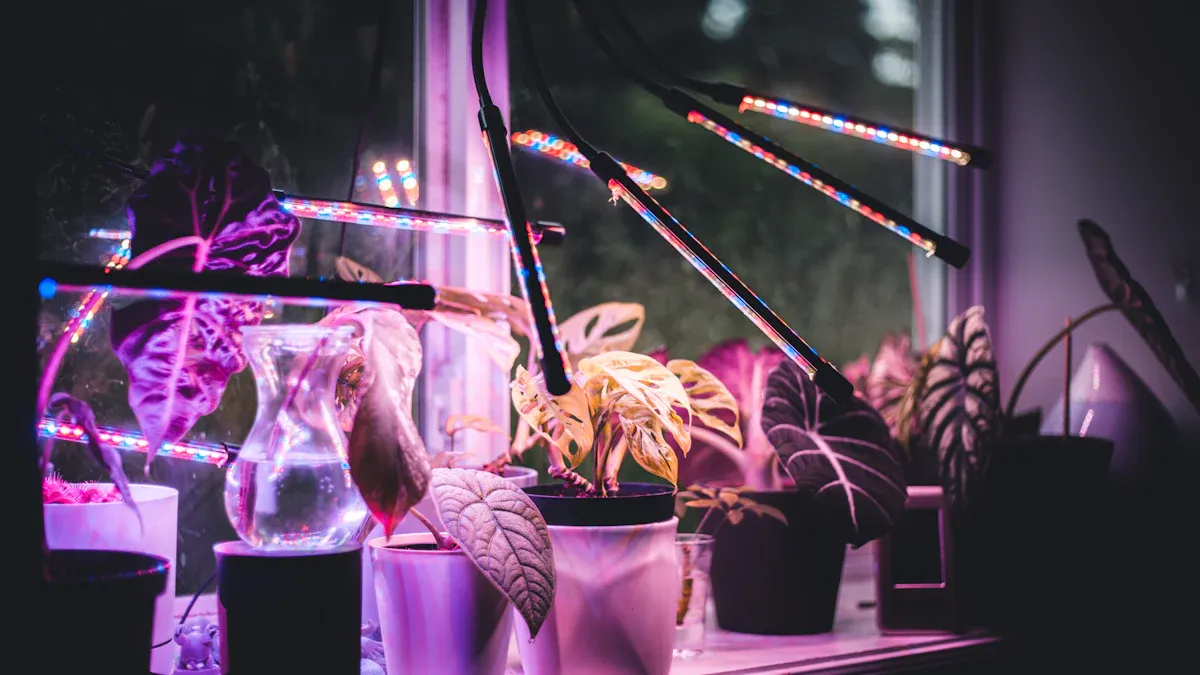
When I grow high-light plants like tomatoes, peppers, or succulents, I always pay close attention to the type of lighting I use. These plants demand strong, consistent light to thrive. In my experience, t8 grow lights deliver impressive results for these sun-loving varieties. The higher PPFD and strong lumen output from t8 make them a smart choice for anyone who wants to see rapid growth and healthy fruiting. I place t8 fixtures close to my plants to maximize light absorption and keep stems sturdy.
Here’s how I compare the best lighting options for high-light plants:
LED grow lights: I love these for their cool operation and long lifespan. They work well for large setups and reduce maintenance.
Fluorescent lights: These offer a budget-friendly solution. I use them when I need to cover a bigger area, but I keep them close to the plants.
T5 fluorescent lamps: These give me low heat and high efficiency. I use t5 for seedlings and young plants that need gentle, yet powerful light.
I always recommend t8 for mature, high-light crops. When I want the best results, I combine t8 with LED fixtures for maximum coverage.
Not every plant needs intense lighting. When I grow herbs, leafy greens, or shade-loving houseplants, I choose my lights carefully. T5 grow lights shine in these situations. Their balanced spectrum and gentle output help me avoid burning delicate leaves. I often use t5 for basil, mint, lettuce, and similar crops.
Here’s a quick table to show which lights work best for low and medium-light plants:
Grow Light Type | Best For | Features |
|---|---|---|
GE BR30 Full-Spectrum LED Grow Light Bulb | Herbs (basil, mint) | Screws into standard lamp socket, 9W LED, medium light intensity, full-spectrum light |
Mars Hydro TS 1000 LED Grow Light | Leafy greens, vegetables | Strong, full-spectrum light, suitable for various growth stages |
I find that t5 and t8 both support healthy growth for these plants, but t5 gives me more control over placement and intensity. I can set up t5 fixtures on shelves or in small spaces, making them perfect for indoor herb gardens.
I always match my lighting to the plant’s growth stage. Seedlings need blue light to build strong roots and stems. T5 and t8 both provide this, but I prefer t5 for starting seeds because of the gentle, even coverage. During the vegetative stage, I use a mix of blue and red light. T8 lights help my plants stretch and fill out, while t5 keeps growth compact and lush.
When my plants reach the flowering stage, I switch to lighting that emphasizes red wavelengths. T8 lights work well here, especially for fruiting crops. I sometimes add LED fixtures to boost red light and encourage more blooms.
Here’s how I break it down:
Seedling stage: T5 for gentle, blue-rich light
Vegetative stage: T8 for strong, balanced growth
Flowering stage: T8 and LED for red-rich light and bigger yields
Tip: I always adjust the height of my lights as plants grow. This keeps the light close and prevents stretching or burning.
When I compare t5 vs t8, I see that both have a place in my grow room. T5 gives me flexibility for delicate plants and early growth. T8 delivers power for mature, high-light crops and flowering. I choose the right light for each stage and plant type, and my harvest always rewards me.
When I plan my grow room, I always compare the cost and lifespan of each lighting option. T5 and t8 both offer strong value, but the details matter. T5 lights usually cost more at the start. I pay extra for higher energy efficiency and a balanced spectrum. Over time, I see savings on my electric bill because t5 uses less power for the same lumen output. T8 lights cost less up front. I find them in most hardware stores, so I can set up a big grow area without breaking my budget. T8 bulbs last longer than t5, sometimes up to 30,000 hours. This means I replace bulbs less often and save money in the long run. If I want the best mix of low cost and long life, t8 gives me a clear advantage. If I want top energy efficiency and strong lighting for delicate plants, I choose t5 grow lights.
Tip: I always check the rated lifespan before I buy. A longer-lasting bulb means fewer replacements and less hassle.
I always look for lighting that fits my space and is easy to install. T5 grow lights make my life simple. Their plug-and-play design lets me upgrade my setup fast. I just mount the fixture, plug it in, and start growing. I can fit t5 into tight shelves or racks because the tubes are slim. T8 grow lights take more work. Sometimes, I need to retrofit old fixtures, especially in older buildings. This can slow me down and add to my costs. T8 tubes are thicker, so I need more space between plants and lights. If I want a quick, hassle-free setup, t5 is my go-to. If I have a bigger area and do not mind a little extra work, t8 works well.
T5: Easy installation, fits small spaces, quick upgrades
T8: May need retrofitting, needs more space, better for large rooms
Keeping my lighting system in top shape is key for healthy plants. I follow a simple routine for both t5 and t8. I clean the lamps and ballasts to remove dust. I replace bulbs every 9 to 12 months or when I see a drop in light. I always unplug the system before I start any work. I never use cleaning solutions on electrical parts. Here is how I break down my maintenance tasks:
Maintenance Task | Description |
|---|---|
Cleaning | Regularly clean lamps and ballasts to remove dust and grime. |
Lamp Replacement | Replace grow lamps every 9-12 months or when light output drops below a certain threshold. |
Safety Precautions | Always unplug the system before maintenance and avoid using cleaning solutions on electrical parts. |
Note: Regular maintenance keeps my t5 and t8 grow lights running at peak performance. Clean lights mean better growth and fewer problems.
I always weigh cost, installation, and maintenance before I choose my lighting. T5 gives me easy setup and strong energy efficiency. T8 offers long life and lower costs for big projects. I pick the lighting that matches my space, my budget, and my goals.
When I look for the best grow light, I always compare the main options side by side. Each type has its own strengths and weaknesses. I want to make sure you get the most out of your indoor garden, so here’s how I see the differences:
Grow Light Type | T5 Tubes | |
|---|---|---|
Efficiency | High | High |
Lifespan | 15,000–45,000 hrs | 50,000 hrs |
Initial Cost | Lower | Higher |
Energy Use | Low | Low |
Hazardous Content | Mercury | None |
Heat Output | Very little | Very little |
Application | Great for cloning | Full cycle, all stages |
I notice that LEDs stand out for energy efficiency. Well-designed LED units produce more light per watt than T5 or T8. This means I save money on my electric bill and avoid heat problems in my grow room. T5 lamps are only about 9% more efficient than T8, so the difference between those two is small. T8 lights use more power and have lower lumen output, which makes them less ideal for serious growers.
Here’s what I like about LED grow lights:
Customized light spectrum for every growth stage.
Energy use is at least 70% less than traditional grow lights.
Long lifespan—up to 50,000 hours.
No mercury or hazardous materials.
But I also consider the drawbacks:
Higher upfront cost.
Sensitive to heat, which can affect performance if not managed.
Note: T8 lights are less energy-efficient and not the best choice for flowering or vegetative phases. I always recommend looking at long-term savings, not just the price tag.
I always ask myself when it makes sense to upgrade to LED. If I want the best results for my plants and my wallet, I choose LED when:
I need to lower my energy bills.
I want a light that lasts for years with little maintenance.
I grow plants through all stages, from seedlings to flowering.
I want to avoid hazardous materials like mercury.
If I run a large grow room or want to automate my lighting, LED gives me more control. I can adjust the spectrum and intensity for each plant. This helps me get bigger yields and healthier crops. The higher initial cost pays off over time because I spend less on electricity and replacements.
Tip: If you want to future-proof your grow setup, invest in LED. The savings and plant health benefits make it worth every penny.
I always look at my goals and budget before making the switch. For most growers who want efficiency, safety, and top performance, LED is the clear winner.
When I start a new indoor garden, I always begin by understanding what my plants need. Every plant has its own light requirements. Most of my leafy greens and seedlings thrive with at least 12 hours of good growth light each day. For the best results, I often provide 16 to 18 hours of lighting. I pay close attention to the type of plant—flowering plants usually need more intense light than herbs or lettuce. I also look at the size of my growing area and my budget before making a decision.
Here’s how I break down my assessment:
I check the light intensity my plants need.
I decide how many hours of light they should get daily.
I research the types of grow lights available and weigh their pros and cons.
Tip: Always match your lighting to your plant’s stage and type. This step ensures healthy growth and strong yields.
Choosing between t5, t8, and led options can feel overwhelming. I simplify the process by comparing the main factors in a table:
Factor | T5/T8 Lights | LED Lights |
|---|---|---|
Light Spectrum | Good for general growth | Can be tailored for specific needs |
Color Temperature | 5000-6500 K for full spectrum | Available in various spectrums |
Energy Efficiency | Moderate energy consumption | Highly energy-efficient |
Lifespan | Shorter lifespan | Longer lifespan |
Plant Requirements | Best for leafy greens and seedlings | Versatile for all plant types |
I use t5 for compact spaces and when I want balanced light for all stages. T5 grow lights give me flexibility and efficiency. When I need to cover a larger area or grow high-light crops, I turn to t8. T8 grow lights deliver strong output and work well for mature plants. For the ultimate in customization and savings, I choose led. Led lighting lets me fine-tune the spectrum and save on energy bills.
Note: I always consider my space, plant type, and budget before making a final choice.
I have learned from experience that some mistakes can set back an entire grow. Here are the most common errors I see:
Using general lighting terms instead of plant-specific needs.
Picking the wrong light spectrum for the crop.
Placing lights too high or too low above the plants.
Not providing enough light coverage for the whole area.
Ignoring the importance of photoperiodism.
Forgetting to manage temperature and humidity.
Not adjusting watering and nutrients when switching to led.
Changing light intensity or height too quickly.
Settling for low-quality fixtures.
Overlooking voltage requirements and daisy chaining.
�� Avoid these mistakes to keep your indoor garden thriving. I always double-check my setup and make adjustments as my plants grow.
By following these steps, I always find the right balance for my garden. I choose t5 for energy efficiency and flexibility, t8 for power and coverage, and led for advanced control and savings. The right lighting transforms my plants and maximizes my harvest.
When I ask myself is t5 or t8 better for grow lights? led grow light, I always look at my plants, budget, and space. T5 works best for energy efficiency and compact setups. T8 fits larger gardens and high-light crops. LED grow light offers the longest lifespan and lowest energy use. Check this table for a quick comparison:
Key Factor | T5/T8 Fluorescent Lights | LED Grow Lights |
|---|---|---|
Energy Efficiency | Moderate | High |
Lifespan | 10,000 hours | 30,000+ hours |
Heat Output | Higher | Lower |
Review your growing goals and space before you decide.
Consult experts if you have unique plant needs.
I always choose the light that matches my setup and helps my plants thrive. Is t5 or t8 better for grow lights? led grow light depends on your goals.
I see the biggest difference in size and efficiency. T5 tubes are slimmer and deliver more light per watt. T8 tubes are thicker and last longer. I choose T5 for compact spaces and T8 for bigger grow rooms.
I use T5 for seedlings, herbs, and leafy greens. T8 works best for mature, high-light plants like tomatoes. I always match the light to my plant’s needs for the best results.
I keep T5 lights 6–12 inches above my plants. T8 lights work best at 8–16 inches. I check for heat and adjust the height to avoid burning leaves.
I believe LED grow lights offer the best energy savings and longest lifespan. I use LED when I want full control over spectrum and lower electricity bills. The higher upfront cost pays off over time.
I replace T5 bulbs every 12–18 months. T8 bulbs last up to 30,000 hours, so I change them less often. I always watch for dimming or color changes.
I find both T5 and T8 lights use less power than older bulbs. T5 is more efficient per watt. I save even more by switching to LED.
Yes! I often combine T5, T8, and LED lights to cover all growth stages. This gives me flexibility and helps my plants thrive from seedling to harvest.
I recommend T5 grow lights for beginners. They are easy to install, energy-efficient, and gentle on plants. I started with T5 and saw great results right away.


 English
